
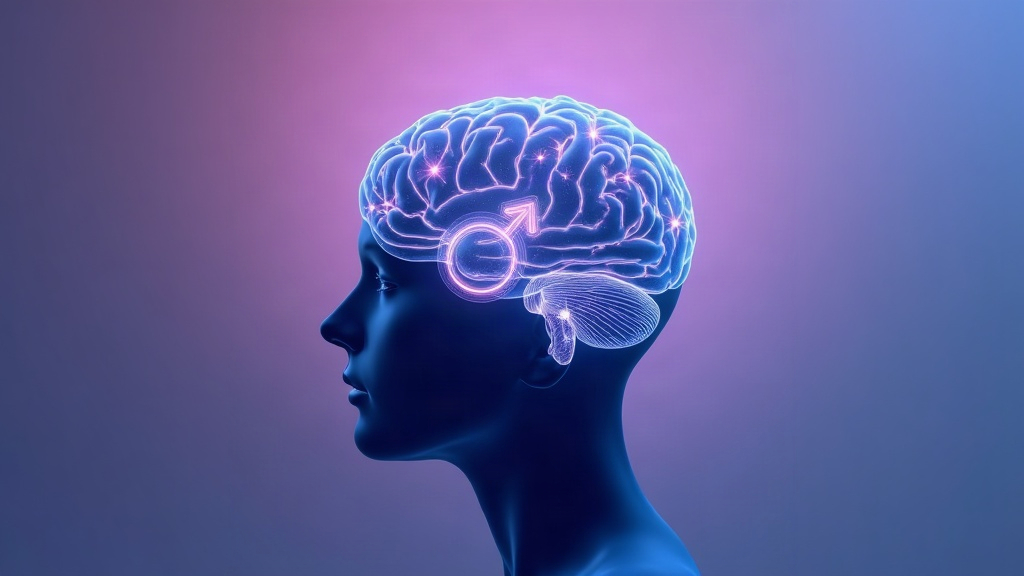
The brain pattern that has been linked to gender identity in trans women is not exclusive to Europe or the United States. A new study carried out in Thailand confirms that this cortical phenotype repeats itself in a very different population and, along the way, separates gender identity from sexual orientation, two factors that are often confused.
Researchers from Canada and Thailand studied 140 Thai adults aged 18 to 44, divided into four groups: cisgender heterosexual men, cisgender gay men, cisgender heterosexual women, and transgender women attracted to men, known locally as «sao praphet song», literally «second kind of woman». Among the transgender women, some had used gender-affirming hormones and others had not. Using magnetic resonance imaging they measured total brain size and the thickness of the cerebral cortex in different regions.
The central result: cortical thickness was associated with gender identity and with hormone use, but not with sexual orientation. Gay men showed a cortex similar to that of heterosexual men. By contrast, female gender identity —both in cisgender women and in transgender women who had not used hormones— was linked to a thicker frontal and parietal cortex.
Among transgender women, those who had received affirming hormones showed a smaller brain size and thinner cortices. The authors interpret that hormone treatment influences cortical morphology, in line with what has been observed in previous studies carried out in Western clinics, but now in a context of self-managed and very widespread use.
The work brings two new contributions. On the one hand, it shows that the brain phenotype linked to gender identity can be generalised beyond Western populations and that it is specific to identity, not to sexual orientation. On the other, it helps to understand the effects of affirming hormones on the brain when their use is decided autonomously, a common practice that is still little studied.
The authors stress the exploratory nature of the work: it is a cross-sectional study with 140 participants, and it does not allow causality to be established or definitive conclusions to be drawn. But it adds evidence that gender identity has measurable biological correlates in the brain across different cultures and populations.
Source: Cortical structure and brain size in Thai transfeminine individuals with and without gender-affirming hormone use compared with cisgender heterosexual men, heterosexual women, and gay men. Skorska MN, Folkierska-Zukowska M, VanderLaan DP, et al. Neuroscience 2026;614:373-384. DOI: 10.1016/j.neuroscience.2026.07.051.
Publication reference: Neuroscience.
Article published on dosier.es. Image generated with artificial intelligence (marta ai → marta.syf.es).