
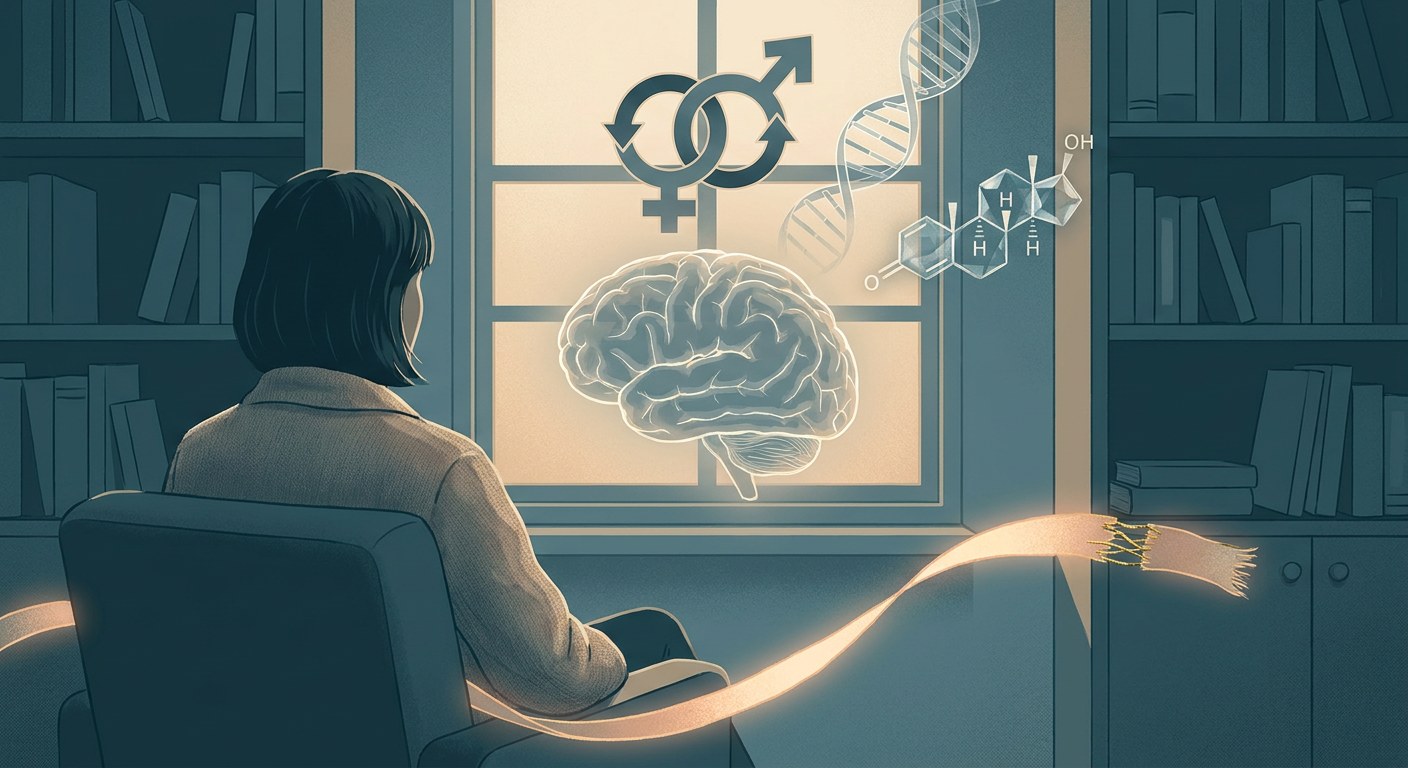
The large majority of people who receive gender-affirming hormone or surgical treatment do not regret it: reviews put regret or detransition between 0% and 10%, and after surgery between 0% and 2.4%. The authors of a paper now published in Archives of Sexual Behavior repeat this several times, because their work is not about that majority. It is about a small group: people who, after taking hormones or undergoing surgery, come to experience that step as harm and suffer because of it, sometimes years later.
The proposal: reading it through the categories of trauma
Alison Clayton and Kathleen McDeavitt, both psychiatrists, argue in this conceptual article that the distress of a subset of people who detransition can be understood with two diagnostic tools from the DSM-5-TR. The first is posttraumatic stress disorder (PTSD): they hold that, for a small number of patients, gender-affirming treatment itself can function as the traumatic event, with intrusive memories, avoidance, negative changes in thinking and mood and hypervigilance. They note that the DSM-5-TR allows for delayed expression of PTSD — it can emerge more than six months after the event, even years later — and no longer requires fear or horror at the time.
The second tool is moral injury. The concept comes from research with war veterans and describes the psychological damage that follows the realisation of a betrayal by someone in a position of authority. In September 2025 the DSM-5-TR added “moral” to the category of religious or spiritual problem (code Z65.8), so it can now be used when a moral problem is the focus of clinical attention. The authors say it fits accounts from people who feel betrayed by their clinicians or by the system meant to protect them, and they also mention “detransphobia”: the stigma and rejection some meet after detransitioning.
The metaphor of a changed gaze
To explain how someone may not have experienced an event as harm at the time and reinterpret it afterwards, the article brings in a much-debated example: women who underwent female genital cutting as children and only read it as mutilation once they move into a different cultural and belief context. The authors state explicitly that they are not equating the two: they use it as a metaphor for “hitting bottom”, that deep shift in which one’s own history moves from being lived with pride to being lived with shame and grief. Along the same lines they cite the Spanish sociologist and trans man Miguel Missé, who has written about the feeling of having been robbed of his body.
What this work is, and what it is not
- It is not a study. It is a conceptual article: it brings no new data and draws on published literature, public accounts gathered from media and social media, and the authors’ clinical experience.
- It does not estimate how many people fit this profile. The authors themselves stress that detransition is heterogeneous, that only a minority of those who detransition do so out of regret, and that their text is limited to that subgroup, without discounting the positive experiences of others.
- Its scope is clinical: it asks professionals to consider trauma and moral injury when assessing a person who detransitions and is suffering, without turning them into an automatic diagnosis. Diagnosis, they recall, requires evaluation in consultation.
- There is a declared conflict of interest: Clayton has served as an expert witness in litigation on gender medicine and has received funding from the Society for Evidence-Based Gender Medicine, an organisation critical of affirmative care. McDeavitt declares none.
The article also appears at a time when the clinical and legal framework for the care of minors with gender dysphoria is under review in several countries. For the non-specialist reader, the main caveat is the usual one in science: a conceptual proposal is not a measurement of frequency, and what it describes as possible in some cases says nothing about the majority. What it does offer is a vocabulary for naming a suffering that these authors consider under-recognised and that, in their view, should not be left out of the consulting room.
Source: Detransition, Posttraumatic Stress Disorder, and Moral Injury. Clayton A, McDeavitt K. Archives of Sexual Behavior 2026. DOI: 10.1007/s10508-026-03669-x.
Article published at dosier.es. Image generated with artificial intelligence (marta ai → marta.syf.es).