

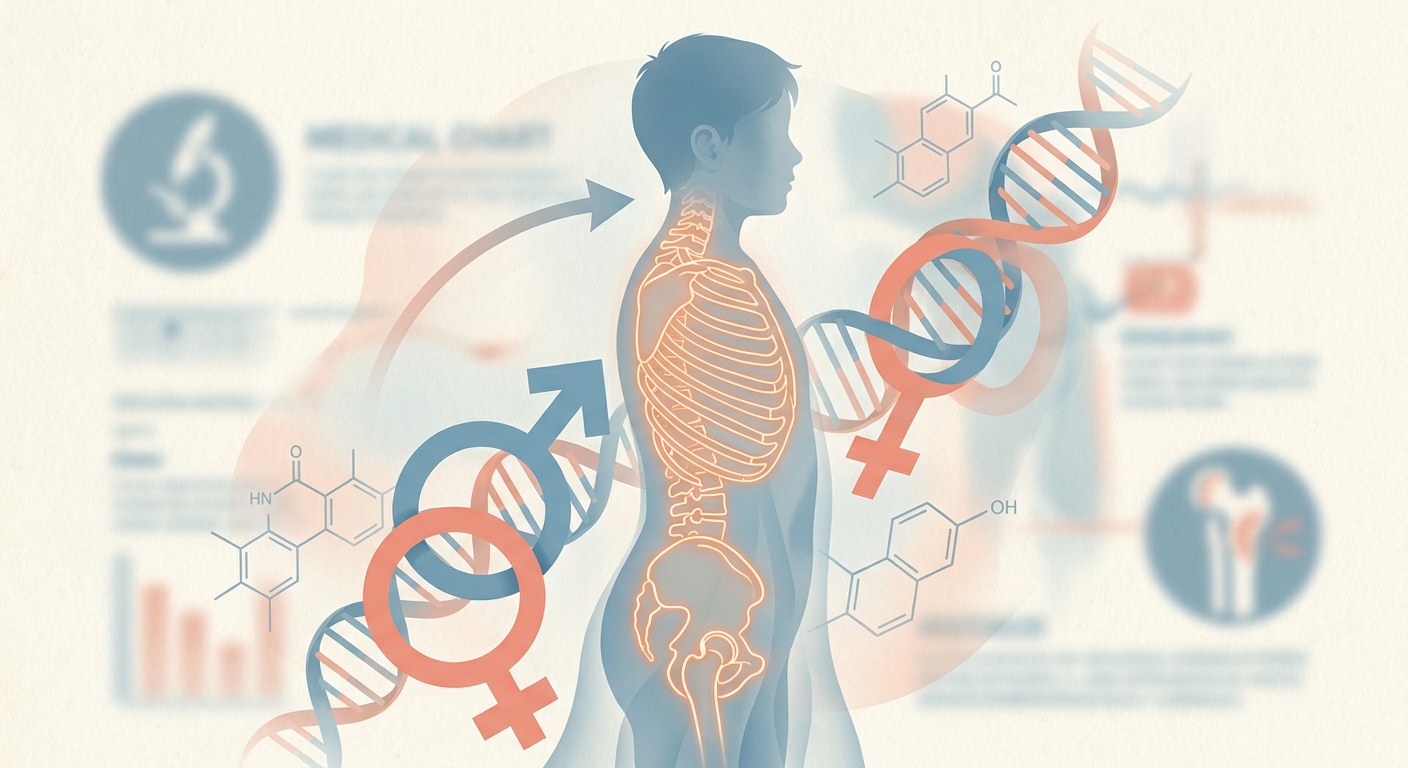
Puberty is the window in which most of the bone mass a person will carry for life is built. So when it is paused with GnRH analogues — the so-called puberty blockers — and gender-affirming hormone therapy is started afterwards, the question about bones is unavoidable. A systematic review and meta-analysis published in JAMA Pediatrics gathers ten cohorts and 751 transgender adolescents and offers a nuanced answer: bone density falls during suppression, partly recovers with hormone therapy, and a permanent deficit is not demonstrated.
What was analysed
The authors searched PubMed, Scopus, Web of Science and the Cochrane Library for longitudinal studies measuring bone mineral density (BMD), bone mineral apparent density and z scores at the lumbar spine, total hip or femoral neck in transgender and gender-diverse adolescents treated with GnRH analogues, with or without subsequent hormone therapy. Ten cohorts met the criteria, covering 751 participants: 427 assigned female at birth and 324 assigned male at birth. Measurements were pooled at three points: before suppression, after suppression and after gender-affirming hormone therapy.
What the numbers show
During pubertal suppression, lumbar spine z scores declined clearly: −0.97 in those assigned female at birth (95% CI, −1.09 to −0.85) and −0.73 in those assigned male at birth (95% CI, −0.93 to −0.53), while absolute bone mineral density stayed stable. In other words, bone was not being destroyed: it simply stopped gaining ground against age-matched references.
Gender-affirming hormone therapy brought the turn. BMD increased, with a mean difference of 0.09 g/cm² in the group assigned female at birth and 0.13 g/cm² in the group assigned male at birth, and z scores recovered partially. At the end of follow-up they remained below baseline (−0.51 and −0.52 respectively), but the differences were not consistently statistically significant across skeletal sites. Recovery was smaller and more heterogeneous at the total hip and femoral neck, where cortical bone responds differently.
The meta-analysis also identified factors linked to better outcomes: higher body mass index, shorter duration of pubertal suppression and longer exposure to hormone therapy. Put simply, the sooner hormone treatment follows the suppression period, the better the skeleton behaves.
What it means for clinical care
For teams supporting transgender adolescents the message is twofold. First, reassuring: no irreversible structural damage attributable to suppression is observed. Second, cautious: z scores below baseline call for bone monitoring, adequate calcium and vitamin D, weight-bearing physical activity and a healthy body weight, and for not unnecessarily delaying hormone therapy when a young person needs it. Bone density is a silent parameter: it does not hurt and cannot be felt, and it is only detected by measuring.
The authors themselves highlight the limitations: the included studies are observational cohorts rather than randomised trials; they use normative references based on sex assigned at birth, which can distort how z scores are read in people who are transitioning; and heterogeneity across centres, protocols and follow-up times is considerable. No review can replace individualised follow-up.
The identity context
The paper does not address the biological basis of gender identity: it measures the effect of a treatment on the skeleton. But it lands squarely in the debate on transgender adolescent care, a field where evidence on bone safety has sometimes been used with more noise than data. Pooled figures with confidence intervals, and without exaggeration in either direction, are exactly what families and the people involved needed.
Source: Bone Accrual During Puberty Suppression and Gender-Affirming Therapy in Transgender Adolescents: A Systematic Review and Meta-Analysis. JAMA Pediatrics 2026;180(10):1094. DOI: 10.1001/jamapediatrics.2026.2470.
Article published on dosier.es. Image generated with artificial intelligence (marta ai → marta.syf.es).