
Some newborns arrive in the world with a sexual development that does not fit the two usual boxes. Their chromosomes, their gonads or their external anatomy do not follow the most common route, and that reality, far from being an anecdotal rarity, fills a good part of the paediatric endocrinology clinic of any large hospital. A team at the Children’s Hospital in Lahore (University of Child Health Sciences, Pakistan) has now reviewed the cases seen over a full decade and published the overall picture: 815 children and adolescents, aged 0 to 18, evaluated between January 2015 and December 2024. The work appears in the journal Pakistan Journal of Medical Sciences.
So-called differences of sex development (DSD) are a broad group of congenital conditions. They are neither a single disease nor a single diagnosis: under that label live very different situations, from a gonad that does not mature as expected to a hormonal output that pushes the body in another direction. What they share is that they force medical decisions and, in many cases, decisions about gender assignment, before the person can speak for themselves.
The first striking figure in the study is the age at which these families reach a specialist: 7.5 years on average. In other words, a large share of cases are not detected in the delivery room, but years later, when something in growth or pubertal development deviates from what was expected. Sixty-two percent of patients were being raised as boys and 38% as girls.
The reasons for consultation draw the daily life of these clinics. The most frequent by far was micropenis (41%), followed by ambiguous genitalia (21.6%) and by conditions discovered in adolescence through delayed puberty or absence of menstruation (20%). None of the three is a loud sign; all require someone to look carefully and ask questions.
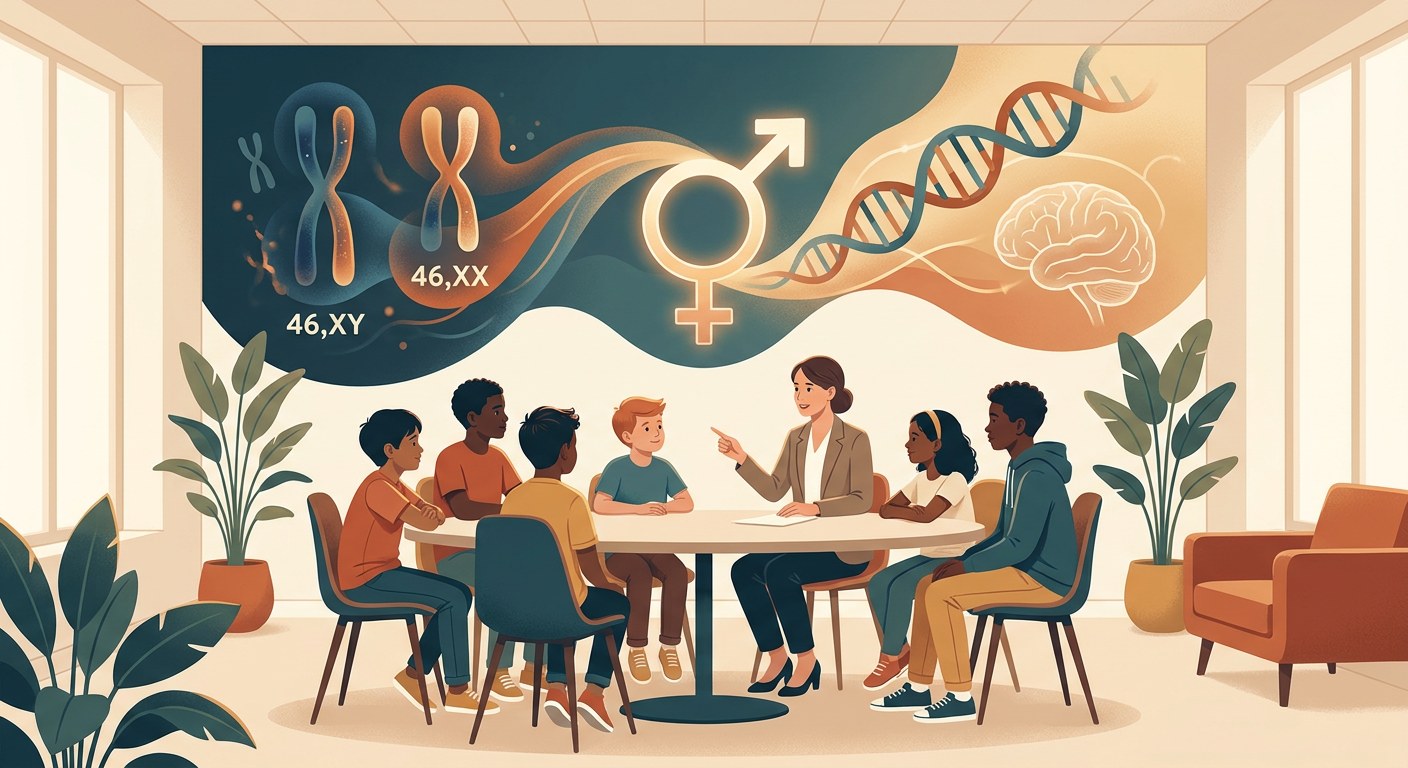
When the authors crossed diagnoses with karyotype, the distribution proved very uneven. The largest group was people with 46,XY chromosomes, 60.7% of cases, explained mainly by two causes: androgen insensitivity and 5-alpha-reductase deficiency, which together accounted for 82.4% within that group. In the 46,XX group, 33.4%, the dominant cause was congenital adrenal hyperplasia (91.6%), a condition in which adrenal hormone production goes off track and virilises development. The remaining 6.6% corresponded to sex chromosome alterations, with Turner syndrome variants the most common presentation. The association between karyotype and diagnosis was statistically solid, with a p value below 0.0001.
The clinical reading of these numbers is concrete. Each karyotype carries a repertoire of likely causes, and knowing them helps target genetic and hormonal testing instead of shooting in the dark. The authors themselves insist on the same conclusions as always, but now with a large series behind them: early and accurate diagnosis, a multidisciplinary team —endocrinology, genetics, surgery, psychology— and training so that frontline professionals can recognise what they have in front of them.
There is also a warning the study drops at the end and that deserves emphasis: the long-term psychological impact. A significant share of people with DSD grow up with interventions decided by others, with incomplete information and, in some cases, with a family silence that hurts more than the clinical condition itself. The review does not measure that impact, but it flags it as the outstanding task.
It is worth being precise on a point that is often confused. Atypical sex development and gender identity are related questions, but not identical ones: most people with DSD do not have gender dysphoria, and most trans people have no DSD. What both worlds do share is the need to listen to the person, to avoid assuming a trajectory, and to accompany with honest information. In that sense, clinical series like this one are useful not only to diagnose better, but to know how many decisions are being made, when, and with what data.
The limits of the work are those of its design: it is retrospective, it relies on the records of a single referral centre, and it includes no follow-up of gender identity or satisfaction with the assignment made. It is a map of what reaches a clinic, not a prognosis of how those people will live their identity in adulthood.
Source: Spectrum and clinical profile of disorders of sex development: A 10 year experience at a tertiary care center. Aslam N, Aftab S, Naseer Khan B, Noor-e-Hira. Pakistan Journal of Medical Sciences 2026;42(9):2497-2502. DOI: 10.12669/pjms.42.9.15195.
Published on dosier.es. Image generated with artificial intelligence (marta ai → marta.syf.es).