

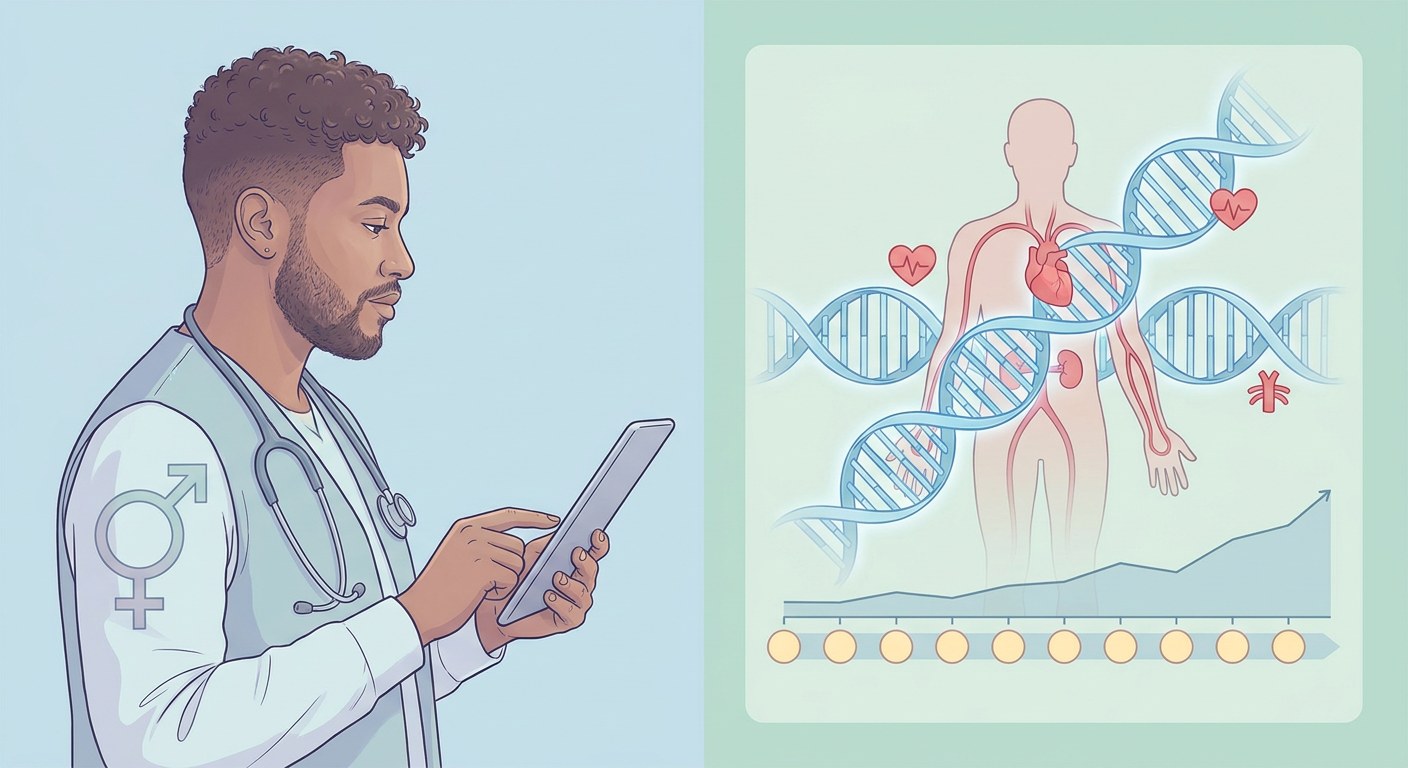
Twenty fingers pressing on the arm of the clinic chair. An electrocardiogram. A blood test with fifteen parameters. And the same question as always: what is testosterone doing to my body, year after year? Until now, few data could answer that in the long term. A new study published in Journal of Endocrinological Investigation has followed transmasculine adults on gender-affirming hormone therapy for ten full years and described, in detail, what changes and what does not change in their metabolism and their heart.
It is a single-centre longitudinal cohort study. The researchers enrolled transmasculine adults who were starting testosterone-based gender-affirming hormone therapy and reviewed them every year according to standard clinical practice. The advantage is huge: instead of photographing a single moment, they could observe the real evolution of the organism across a complete decade.
What they found in metabolism
Body weight and fat mass followed a slow but steady upward trend. It was not a sharp jump: it was a very gradual drift, year after year, that persisted even after adjusting for other factors. The authors stress that this evolution must be read in the context of a population that, like everyone else, also ages and changes its habits.
The lipid profile, the fats in the blood, showed movements worth watching. Some markers associated with cardiovascular risk tended to rise over time under androgenic therapy. It is not a sentence: it is a fact that calls for periodic monitoring. Gender-affirming medicine, the authors point out, does not end when the dose is adjusted; it demands ongoing metabolic follow-up.
The heart, a delicate balance
The cardiovascular system is where the study asks for the most caution. The observed changes in risk factors, although moderate in the short term, may add up over the years. That is why the authors insist that cardiovascular assessment become part of the routine care of trans men on hormone therapy, just like bone density or liver function checks.
A reassuring reading also emerges from the work: most parameters stayed within manageable ranges across the full decade, and no dramatic decompensations were detected. The challenge is not the drug itself, but the sum of dose, age, genetics and lifestyle of each person.
Why this matters for gender dysphoria
These data are directly relevant to people with gender dysphoria who receive affirming treatment. One of the biggest clinical unknowns of transition had been, precisely, the very-long-term cardiovascular effect of testosterone. This ten-year follow-up offers a first piece of real evidence, not a theoretical model nor an alarmist warning.
It lets those starting treatment know, with concrete figures, what to pay attention to: weight, blood fats, cardiac risk markers. And it lets endocrinologists tailor their monitoring. Knowledge reduces uncertainty, and uncertainty had been, until now, one of the greatest sources of distress associated with the process.
The study also opens new questions: what happens between ten and twenty years? How do these trends interact with surgical menopause or with other treatments? Answering them will require new cohorts and more time. Meanwhile, the clinical message is clear: safe treatment, but never without follow-up.